
At SolarPACES 2025—the world’s premier elite forum for concentrated solar power and chemical energy systems—the COOPERANT project deployed a coordinated, two-pronged presentation strategy to capture the attention of both global academia and commercial sector giants.
The conference, held in the historic heart of Italy, brought together the leading international authorities on solar thermal technology. Recognizing the scale of the audience, the COOPERANT consortium divided its focus to demonstrate both the grand strategic vision of the project and the highly detailed engineering driving its hardware.
Grounding the Project: The Macro View
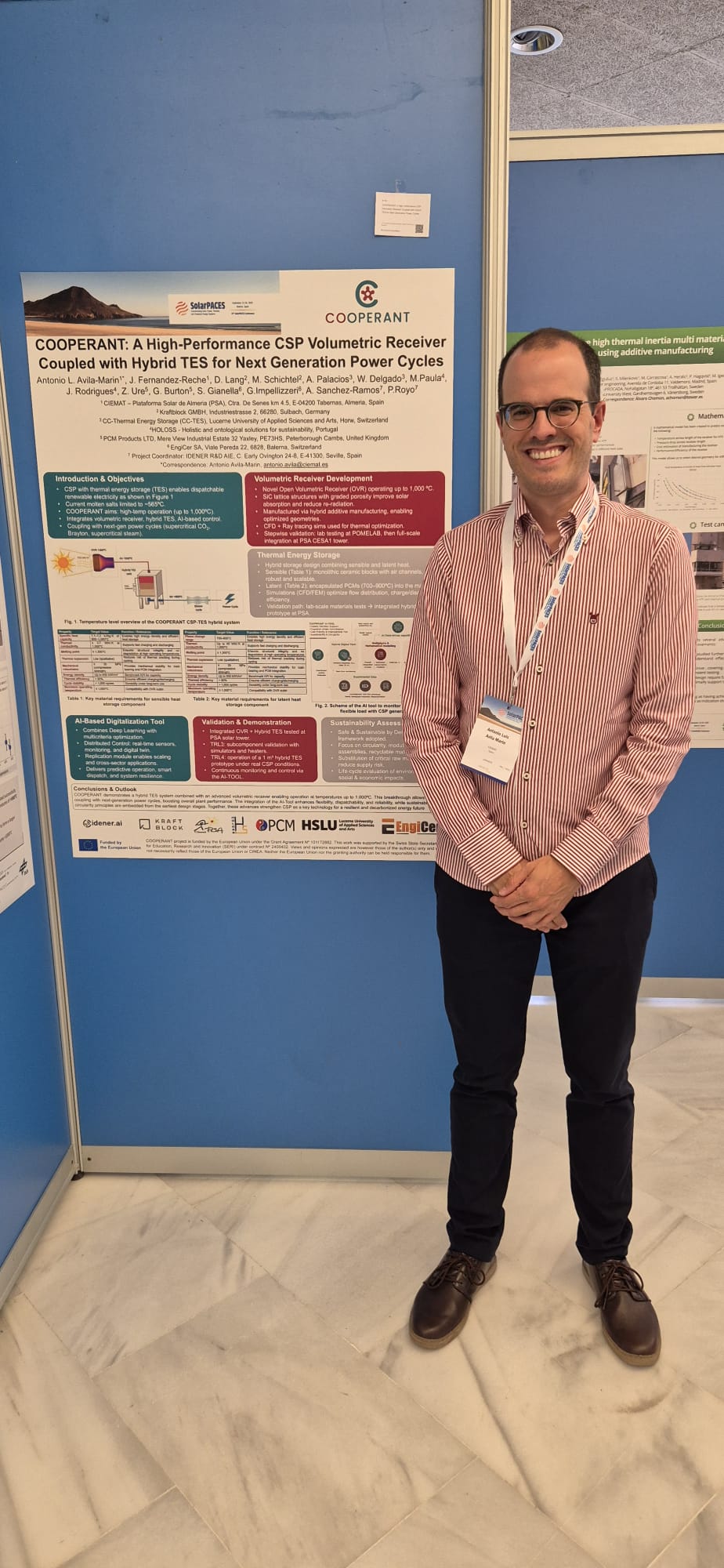
Antonio Avila, representing the Spanish research giant CIEMAT, anchored COOPERANT’s presence by delivering an exhaustive, macro-level breakdown of the overall project mission.
Avila’s presentation served as a status report for the international community, highlighting how COOPERANT is structurally designed to solve the single greatest flaw holding back renewable grids: intermittency. By showcasing the project’s integrated roadmap—which links extreme-temperature solar collection directly to optimized storage networks—CIEMAT demonstrated to global stakeholders that COOPERANT is uniquely positioned to deliver reliable, dispatchable green power on an unprecedented scale.
Engineering the Details: Redesigning the TES Unit
While CIEMAT handled the overarching vision, Anabel Palacios from the Lucerne University of Applied Sciences and Arts (HSLU) dove straight into the microscopic and structural mechanics of the actual hardware.
Palacios presented a highly technical abstract and poster titled “Showcasing alternative configurations of the TES unit design.” This session gave competing engineers and material scientists a first look at the internal blueprint of COOPERANT’s Thermal Energy Storage (TES) system.
Palacios detailed how the team is experimenting with alternative geometric arrangements and material layerings within the storage tanks to maximize heat retention and minimize structural fatigue. Because the system operates at temperatures pushing toward 1,000°C, traditional container designs simply will not suffice. The HSLU presentation revealed how alternative configurations could drastically cut down heat loss while keeping manufacturing and material costs economically viable for commercial developers.
The Verdict from Almeria
The dual-layered showcase cemented COOPERANT’s reputation as one of the most structurally ambitious and technically rigorous initiatives currently funded by the European Union’s Horizon Europe framework. By appealing simultaneously to the industrial developers looking at the big picture and the mechanical engineers looking at structural schematics, the COOPERANT team left Almeria with a bolstered network of international collaborators.
Scientific Resource: Dive into the technical schematics and abstract presented by the engineering team via the official Zenodo repository: DOI 10.5281/zenodo.19353989
Join the Community: Want to see what these high-temperature storage units actually look like in development? Follow us on Instagram for technical insights and project updates: @COOPERANTproject